
Meigs Parole and Probation Compared
Parole and probation both permit a person to live in the community under rules, but they begin in different ways. Parole follows a period of state confinement and depends on a Tennessee Board of Parole decision or another lawful release mechanism. Probation is imposed by a court. It may replace incarceration, follow a jail term, or suspend part of a sentence. Neither label means the case has vanished. Both can continue after the person has left the Meigs County Jail.
Meigs County has a second distinction that matters. The county Probation Office handles misdemeanor probation work, while TDOC Community Supervision handles felony probation and parole through its district structure. A misdemeanor probationer may not appear in TDOC FOIL. A parolee or felony probationer often will. The signed probation order and the exact FOIL status are stronger than a guess based on where the person was once held.
| Feature | Parole | Probation |
|---|---|---|
| How it begins | Release from state confinement under Board and TDOC procedures | A sentence or order entered by the court |
| Meigs authority | Tennessee Board of Parole for decisions; TDOC for field supervision | Meigs County office for misdemeanor matters; TDOC for felony matters |
| Public verification | FOIL status, Board records, and completed TDOC release material | Court order, FOIL for felony probation, or local office jurisdiction check |
| End point | Discharge, sentence expiration, or another final supervision action | Completion or discharge under the governing court and agency record |
- Parole
- Community supervision after release from state confinement.
- Probation
- Court-ordered supervision that may replace or follow time in jail.
- Discharge
- The formal end of the sentence or supervision obligation shown by the responsible authority.
- Absconder
- A supervision term for a person alleged to have stopped reporting or whose location is unknown. It does not prove present custody.
Verify Meigs County Post-Release Supervision
Start with identity, not a broad assumption. TDOC's Felony Offender Information Lookup, known as FOIL, covers people currently or formerly in TDOC custody or supervision. Its result may use the exact status labels incarcerated, probation, parole, or inactive. It may also show location, offense, sentence, hearing, and release information. FOIL does not include every local misdemeanor case, so a blank result cannot settle a Meigs County probation question.
A careful search keeps county jail release, state supervision, and current custody separate. The Meigs County Jail can confirm when its own booking ended. FOIL can show a TDOC supervision record. The trial court order establishes whether probation was imposed and which case it belongs to. If a person appears as incarcerated at another site after leaving the Meigs jail, that points to transfer, not community release.
- Collect the full legal name, a known alias, date of birth, court case number, and TDOC or State ID when available.
- Search FOIL by TDOC or State ID first. For a name search, compare the returned identifiers and do not merge people with similar names.
- Open the detail and record the exact status, location, sentence, parole-hearing, and release labels with the date checked.
- Read the Meigs court probation order to learn whether the case is a local misdemeanor or a TDOC-supervised felony.
- Use the correct office directory to confirm agency jurisdiction. Ask for public status information, not private reporting instructions.
- Confirm present physical custody with the jail or holding agency if a warrant, transfer, or new arrest is involved.
For the broader county release trail, the Meigs County released inmate search explains how the jail record and court disposition fit around a supervision result.
Note: A released person usually leaves a live jail view, while a parole or probation record can remain active after that jail stay ends.
Meigs Probation Uses Two Offices
The Meigs County Probation Office is in the county courthouse and handles misdemeanor probation. Its published duties include meeting clients, attending local court sessions, issuing probation violations, and collecting court costs, fines, and probation fees. That local role must not be folded into TDOC supervision. A court order for a misdemeanor may point here even when FOIL has no public match.
Meigs County Probation Office
17214 TN-58, Suite 203
Decatur, TN 37322
Phone: 423-334-9673
Fax: 423-334-4760
Monday, Tuesday, Thursday: 8:00 a.m. to 3:00 p.m.
Friday: 8:30 a.m. to 4:30 p.m.
Saturday juvenile hours: 9:00 to 11:30 a.m.
Felony probation and parole for Meigs County route through TDOC Community Supervision District 30. The official field office directory assigns Meigs and Monroe Counties to the Madisonville office. An office can clarify which unit serves the case, but it is not an open people-search tool. FOIL and the governing court or Board record remain the public starting points.
TDOC Community Supervision, District 30
123 Pedigo Road
Madisonville, TN 37354
Phone: 423-442-7409
Fax: 423-442-7418
Meigs Parole Hearing Status
The Tennessee Board of Parole is the decision body. It conducts initial, revocation, rescission, time-setting, and appeal hearings at state prisons, county jails, and other detention sites. Hearing officers develop facts and make recommendations. Board members issue the final action. For that reason, a planned hearing or favorable recommendation does not prove that a Meigs County person has left confinement.
The Board's hearing schedule hub explains how to obtain current prison and county-jail schedules. The Board says schedules are updated weekly, normally Monday, or Tuesday after a Monday holiday. Current schedules may be requested from BD.HearingSchedules@tn.gov, and last-minute changes can be checked with the Hearings Division at 615-741-1150. A schedule is evidence of a planned proceeding only.
The official Board Operations route supplies nonconfidential final-decision material. A useful request gives the full offender name, TOMIS number, and requester address. The Board publishes a copy charge of $0.15 per page plus reasonable labor and says it sends a cost letter within seven working days, or a delay notice. An audio request has separate identification and payment rules. After a grant, release can still wait on required programming, an approved plan, a parole certificate, the eligibility date, and final warrant or detainer checks.
The official Board hearing instructions are shown in the Tennessee parole-hearings source.
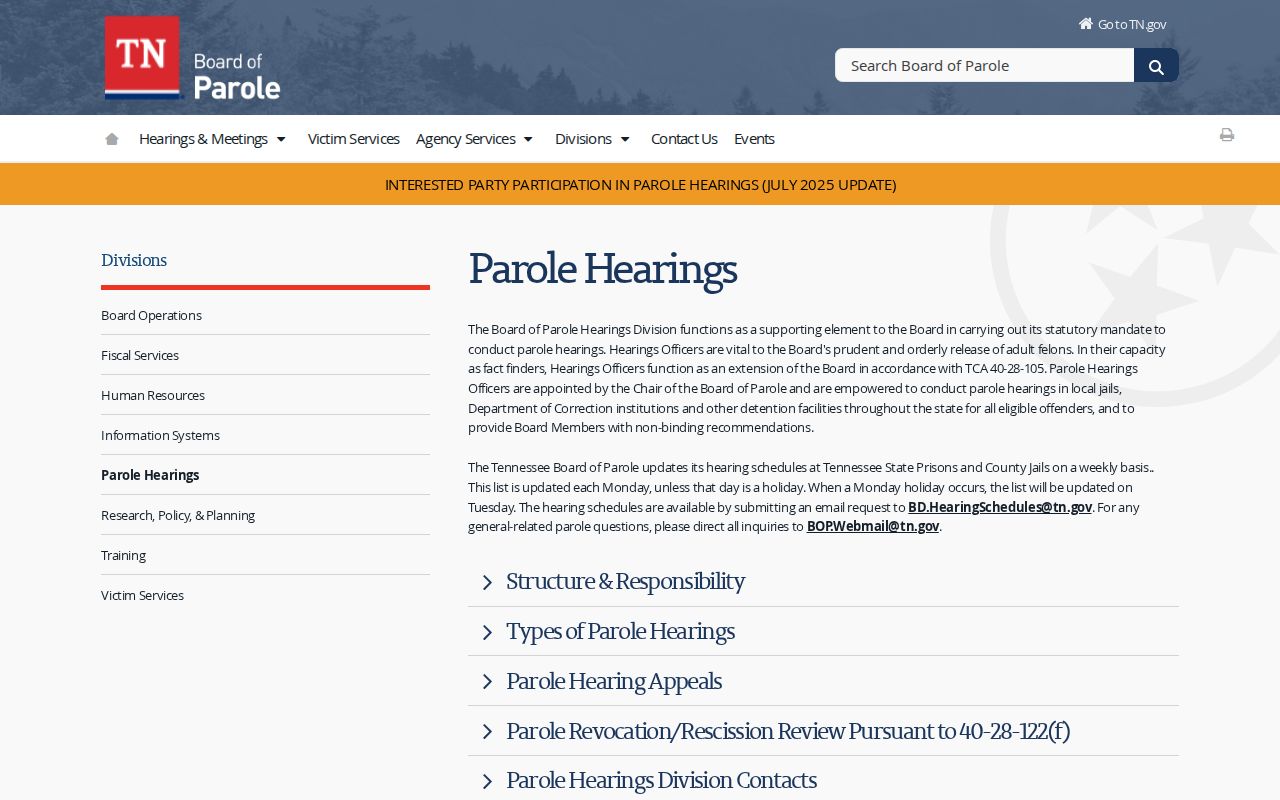
The image identifies hearing types and the scheduling process, but a completed FOIL release event or TDOC record is still needed to prove an actual release.
Meigs Parole Warrants and Absconders
The Meigs Sheriff's Warrants Division is a local warrant channel. It is not a complete, live list of TDOC absconders or every person wanted in Meigs County. A warrant supports an outstanding legal process. It does not show that the person is now inside the county jail. An absconder notation likewise describes alleged supervision noncompliance or an effort to locate the person, not a confirmed jail booking.
Verify each fact with the agency that owns it. TDOC confirms state supervision status. The court or Board record documents a violation, revocation, or warrant action. The Meigs jail or another named holding agency confirms physical custody. These events can occur on different dates. Someone may have been released earlier, then arrested on a supervision warrant later. A missed FOIL result alone is not enough to label anyone an absconder.
| Question | Best record | What it does not prove |
|---|---|---|
| Is state supervision active? | FOIL and TDOC supervision record | Current physical custody |
| Was a violation filed? | Court or Board docket and order | That the allegation was sustained |
| Is there a local warrant? | Sheriff or court warrant record | That an arrest has occurred |
| Is the person held now? | Current record from the holding agency | The result of the supervision case |
Correct Meigs Supervision Release Records
Meigs County Jail houses both local and state inmates. That overlap makes the legal custodian the first question when a release or supervision entry appears wrong. Ask the Sheriff's Department about its county booking, movement, and release fields. Ask TDOC about FOIL status, a felony sentence calculation, or a state release record. A mistaken judgment, probation order, or disposition belongs with the court that entered it.
A focused correction request names the disputed field and supplies an authoritative record that shows the conflict. For FOIL, keep the name or ID used, the date searched, and the exact status wording. For a Meigs booking, identify the booking number and release date range. For a court issue, use the case number and signed order. A public-record request can obtain a copy, but it does not by itself force one agency to change data created by another.
TDOC's sentence-information channel is useful when a release or eligibility date needs an agency calculation. Archived state material can be requested from TDOC Records Management when the public display is unclear. Those routes preserve the split between the local jail clock, the court order, and TDOC sentence control.
Meigs Parole Regional Structure
Meigs County does not operate its own parole board. Decisions come from the Tennessee Board of Parole, field supervision comes through TDOC, and parole-hearing support for this part of the state uses the East Tennessee regional structure. The East Tennessee Regional Parole Hearings Office is at 1426 Elm Street in Knoxville and lists 865-582-2050. That hearing office is not automatically the place where a supervised person reports.
Reporting location must come from current TDOC directions, the release plan, or the supervising officer. For Meigs and Monroe Counties, the public field-office directory identifies District 30 in Madisonville. Keeping the hearing office and field office distinct prevents a common routing error. It also explains why a county employee cannot issue or revise a state parole decision.
Note: Use the Board for hearing records, TDOC for felony field supervision, and the Meigs office only for its published misdemeanor probation role.
Meigs Supervision Conditions and Discharge
Conditions are the rules attached to parole or probation. They can involve reporting, approved residence or travel, treatment or programs, payments ordered by a court, and compliance with the law. The controlling order, parole certificate, and supervising agency instructions define the real terms. Public summaries should not be used to guess a person's private reporting steps.
A suspected violation does not end supervision by itself. It may lead to a filing, warrant, hearing, revocation, reinstatement, or another order. Revocation means supervision is withdrawn after the required process and custody may resume. The Board conducts parole revocation proceedings, while the appropriate court handles probation matters under its authority. Current custody must still be checked separately.
Supervision ends through a formal discharge, sentence expiration, or other final action recorded by the responsible agency or court. A completed TDOC letter of discharge can distinguish a finished sentence from release to a detainer. FOIL may later show inactive, but the discharge or release record gives the stronger explanation. The exact end date should come from that document, not from the last day a name happened to appear online.